FODM and the National Park Service (NPS) have undertaken a project to save some of the preserve's pumpkin ash trees (Fraxinus profunda) from the emerald ash borer (EAB) (Agrilus planipennis), an invasive insect that has been documented in Northern Virginia and will kill all species of ash trees, according to U.S. Department of Agriculture experts.
News

On September 28-29, 2015, National Park Service (NPS) and U.S. Army Corps of Engineers (COE) officials met to begin the design of the restoration of Dyke Marsh under a NPS-COE interagency agreement. Officials estimate the design phase will take at least 12 months.
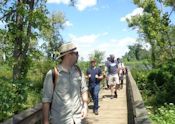
On the lovely, warm, sunny day of August 8, 2015, I led 19 ecology students and professional ecologists and one child for a too-abbreviated visit to the Dyke Marsh Wildlife Preserve (DMWP), as part of the special 100th anniversary meeting of the Ecological Society of America being held at the Baltimore Convention Center.
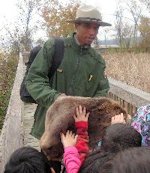 Sixty Belleview Elementary School students, teachers and parents visited the Dyke Marsh Wildlife Preserve on a blustery November 4 to learn how animals and plants in the wetland ecosystem are preparing for winter. National Park Service rangers Emily Zivot and Miguel Roberson led the walk. FODM President Glenda Booth attended the walk and provided the following photo essay.
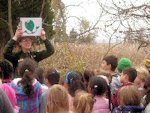 Standing on the wooden bridge, Ranger Emily Zivot told the youngsters that the “sad looking plants” caked in mud and disappearing into the muck are spatterdock, a common wetland plant.
Ranger Miguel Roberson let the students feel a beaver pelt and explained that beavers live in Dyke Marsh (photo at top).
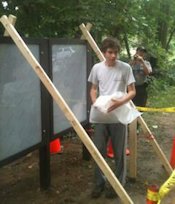 Carson Cameron at the newly installed bulletin bd. Photo by Scott Cameron.On August 9, 2014, Carson Cameron and his Boy Scout Troop 1509 colleagues installed a new bulletin board and bicycle racks at the Haul Road entrance as an Eagle Scout Service Project. Carson organized 16 boys and adults who worked diligently from 8 a.m. to 2:00 p.m. FODM thanks Carson, his helpers and the National Park Service for the new bulletin board.
By Erik Oberg, Biologist, NPS
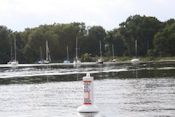 Buoy at the Belle Haven Marina. Photo by NPS.On September 27, NPS's Natural Resources and Lands staff marked Dyke Marsh's federal boundary in the Potomac River with 11 buoys. This marks the end of four years of work to secure the approvals, permits and funding to help visitors see and understand the full extent of Dyke Marsh and how much land has eroded since the NPS began managing the marsh.
Working as a team, park staff safely moved and set over 3,300 pounds of concrete anchors, buoys and chain. With excellent satellite reception, anchors were placed within 17 inches of the target for every location. Each anchor was given enough chain to allow for site-specific water depth, anchor sinkage, tide and peak flood variation.
In addition to placing all 11 boundary buoys, NPS staff also gave assistance to U.S. Geological Survey researchers by extracting three soil cores from the marsh. These cores will be analyzed to provide a millennium-scale climate record of the region and supplement a new joint publication.