Beginning in 2000 and for several years since, Fairfax County has sprayed over thousands of acres targeting a native moth caterpillar called the fall cankerworm (Alsophila pometaria). The National Park Service does not spray its properties, but a phenomenon known as “pesticide drift” can occur and chemicals can end up on unintended properties. We estimate that at least 110 kinds of butterfly and moth caterpillars are at risk of being killed by this insecticide.
News
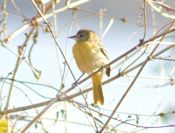
In mid-December 2016, FODMers spotted a Baltimore oriole (Icterus galbula) in Dyke Marsh, a rare winter sighting in Northern Virginia. These birds typically migrate to Mexico, Central America and Cuba during the winter months and are likely vagrants here that have either failed to migrate or have stopped short of their final migration destination.
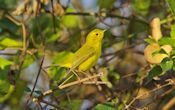
Wilson’s Warbler
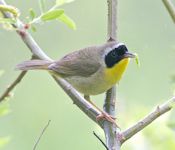
In early December 2016, sharp observers spotted two warblers in the Dyke Marsh Wildlife Preserve, birds that normally would be much further south in December.
A Wilson’s warbler (Cardellina pusilla) (photo by Ed Eder), a beautiful citrine yellow, long-distance migrant is apparently overwintering in the marsh.
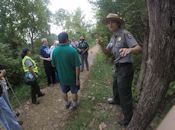
FODMers Jessie Strother and Ned Stone helped National Park Service staff lead a multi-sensory nature walk for low-vision and blind people in Dyke Marsh on September 24, 2016. The group was led by Park Ranger Rachel LeQuire ( photo, by Mary Bielamowicz). As the group of 15 walked along the Haul Road trail, they felt tree bark, snake skins and animal pelts.
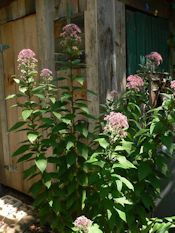
We can bring back functional ecosystems, Dr. Doug Tallamy explains in “Hometown Habitat,” a film that FODM featured at the November 16, 2016, meeting. He describes the effort as “healing the Earth, one yard at a time.” Dr. Tallamy is Professor and Chair of Entomology and Wildlife Ecology at the University of Delaware and the author of Bringing Nature Home.
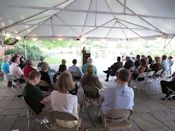
On October 2, 2016, 125 friends and supporters of the Dyke Marsh Wildlife Preserve (photo by Ned Stone) celebrated the 40th anniversary of the Friends of Dyke Marsh, the 100th anniversary of the U.S. National Park Service and the start of marsh restoration. FODM thanks the many generous members, friends, volunteers, sponsors and donors who made the celebration possible. See the lists below.